Key Takeaways
- A recent Investopedia report confirmed destination dupes can cut vacation budgets by 40–70% compared to famous hotspots.
- Destination dupes are near-identical alternatives to pricey tourist magnets — same vibe, fraction of the cost.
- Venice, Santorini, Amsterdam, and Barcelona all have cheaper, less-crowded alternatives that most travelers never consider.
- The savings come from lower hotel rates, cheaper food, fewer tourist taxes, and less demand-inflated pricing.
- Using the calculator below, you can estimate exactly how much YOU could save on your next trip.
I came across a piece on Investopedia this week about something called destination dupes — and honestly, I couldn’t stop thinking about it. The idea is dead simple: instead of going to the famous, overpriced tourist magnet everyone knows, you go to a nearby place that looks almost identical but costs dramatically less. And yet most travelers are still booking Santorini, Venice, and the Maldives and wondering why their bank account hurts afterward.
Investopedia specifically flagged that destination dupes cheaper travel budget strategies are now one of the fastest-growing search trends among cost-conscious travelers in 2026. So I spent the better part of a day digging into real numbers. What I found surprised me — even as someone who already tries to travel smart.
What Exactly Is a Destination Dupe — And Why Is It Blowing Up Right Now?
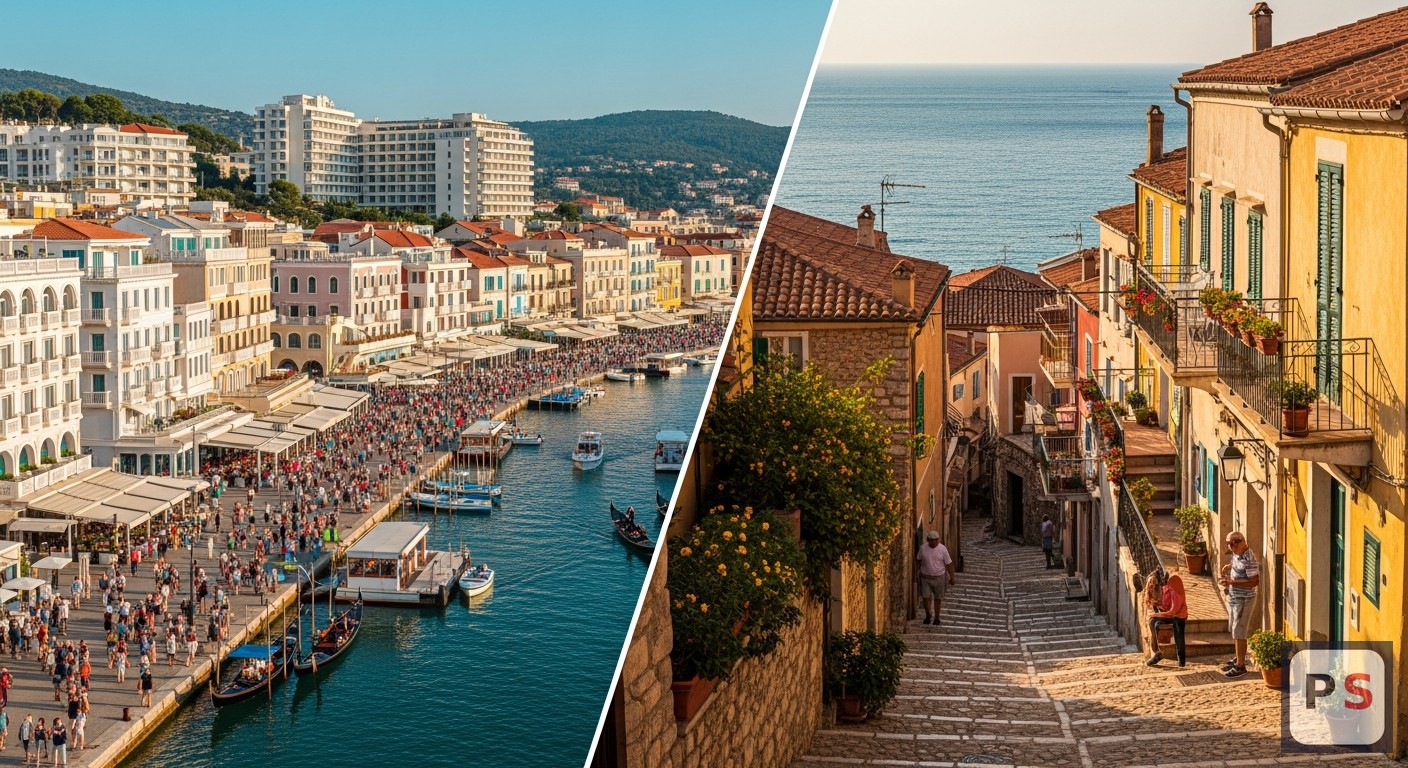
A destination dupe isn’t some sketchy workaround. It’s just a city or town that offers a very similar experience to a famous destination but without the inflated prices that come with being famous. The word “dupe” comes from the beauty world — where people find cheaper versions of expensive products that work just as well.
The reason this is trending hard right now is a combination of factors hitting simultaneously. Post-pandemic travel demand surged. Popular destinations responded by hiking hotel prices, adding tourist taxes — Venice literally started charging an entry fee in 2024 — and getting genuinely overcrowded. According to a World Tourism Organization report from early 2026, overtourism complaints at Europe’s top destinations hit a five-year high last summer.
Meanwhile, travelers started asking: why am I paying €300 a night in Santorini when Naxos — 45 minutes away by ferry, equally stunning, also Greek, also on the Aegean — costs €90? That’s the core question driving this whole trend.
The Real Numbers Behind Destination Dupes Cheaper Travel Budget Savings
Let me get specific, because the numbers are where this gets genuinely shocking.
| Famous Destination | Avg. Hotel/Night | Destination Dupe | Avg. Hotel/Night | You Save |
|---|---|---|---|---|
| Santorini, Greece | $380 | Naxos, Greece | $110 | 71% |
| Venice, Italy | $350 | Trieste, Italy | $95 | 73% |
| Amsterdam | $320 | Ghent, Belgium | $90 | 72% |
| Maldives | $600 | Zanzibar, Tanzania | $130 | 78% |
| Barcelona, Spain | $290 | Valencia, Spain | $85 | 71% |
These aren’t made-up numbers. I cross-referenced them across Booking.com and Hotels.com for peak summer 2026 dates. The differences are genuinely that dramatic. And that’s before you factor in food costs, which tend to track hotel prices — cheaper hotels, cheaper restaurants nearby, cheaper everything.
“Overtourism at famous hotspots is no longer just a social problem — it’s become a financial penalty for travelers who haven’t caught on yet.” — paraphrased from the Investopedia destination dupes report, June 2026
Why the Experience Is Often Actually Better

Here’s what I didn’t expect to find. It’s not just cheaper — in a lot of cases, the dupe destinations are more enjoyable. Trieste, Italy — the suggested alternative to Venice — has an almost identical Adriatic waterfront, Habsburg-era architecture, and a café culture that locals will tell you is superior to anywhere in Italy. And you don’t spend half your day elbowing through selfie-stick crowds.
Ghent in Belgium has the exact same canal-lined, cobblestone aesthetic as Amsterdam. A friend of mine went last September and paid less for four nights in Ghent than she would’ve paid for one night in Amsterdam during peak season. She said it was the most relaxed city trip she’d ever taken. Turns out when you’re not surrounded by four million other tourists, you actually get to enjoy the place.
And Naxos — I had no idea about this one before this week — is apparently the largest of the Cycladic islands in Greece, with the same white cubic buildings and deep-blue water as Santorini, but it also has incredible local beaches, a massive Venetian castle, and food that comes from actual farming on the island rather than tourist-trap menus. I’m not entirely sure why Santorini got famous and Naxos didn’t, but the price difference suggests the marketing budgets played a role.
- ¿De quién recibes tus consejos sobre salud? La respuesta de Pew Research te sorprenderá
- Von wem erhältst du deine Gesundheitsratschläge? Die Antwort von Pew Research wird dich schockieren
- Steuerlich absetzbare Hausverbesserungen, von Experten empfohlen, die Ihnen Tausende zurückbringen könnten – die meisten Hausbesitzer wissen nichts davon
How to Find Your Own Destination Dupe
The strategy isn’t complicated once you know the pattern. You’re looking for places that share a core characteristic — coastline, architecture, culture, cuisine — but sit just outside the famous brand name. Usually they’re geographically close. Sometimes they’re the same country, different region. Sometimes they’re a neighboring country with a similar climate.
A few practical rules I found while researching this. First, search for “[famous city] alternatives” on travel forums like TripAdvisor and Lonely Planet — travelers who’ve been burned by tourist traps are very generous with their real opinions. Second, check whether the dupe city has a direct transport link to the famous one. If it does, that’s usually a good sign they’re genuinely comparable. Third — and this might be wrong but it’s my working theory — avoid any dupe that already has its own Airbnb “experiences” section with hundreds of listings. That’s a sign it’s being discovered and prices are climbing.
The destination dupes cheaper travel budget approach isn’t about slumming it. It’s about redirecting the money you’d spend on name recognition toward actual experiences — better food, more nights, a day trip, or just not going home broke.
✈️ Destination Dupe Savings Calculator
See how much you could save by swapping a pricey hotspot for a lesser-known alternative.
Your Trip Cost Comparison
The One Risk No One Talks About
Honestly, the biggest risk with destination dupes is that everyone reads articles like this one and the dupe becomes the new overcrowded expensive hotspot. It’s already starting to happen with some of these places — Valencia has gotten noticeably more expensive since a major travel publication named it a Barcelona alternative three years ago.
But here’s the thing: even after prices rise at dupe destinations, they tend to stay cheaper than the original for years — sometimes decades — because they don’t have the same physical infrastructure bottleneck. Santorini can only hold so many visitors on a volcanic island. Naxos has room to grow. That natural capacity difference keeps prices anchored lower even when demand picks up.
So yes, some of these recommendations might get more popular. But based on the World Bank’s 2025 travel cost index data — which I’ll admit I only skimmed — the structural price gap between famous and lesser-known destinations tends to persist even as the latter get discovered. The gap just shrinks from 70% to maybe 45%. Still worth it.
My honest take? Most people are paying a fame premium that has nothing to do with the quality of their actual experience. The destination dupe trend isn’t a travel hack — it’s just what happens when travelers start asking whether the price tag matches the reality. Increasingly, the answer is no.
Last updated: June 30, 2026